The local picture
Crawl space problems are a Raleigh-Durham fact of life
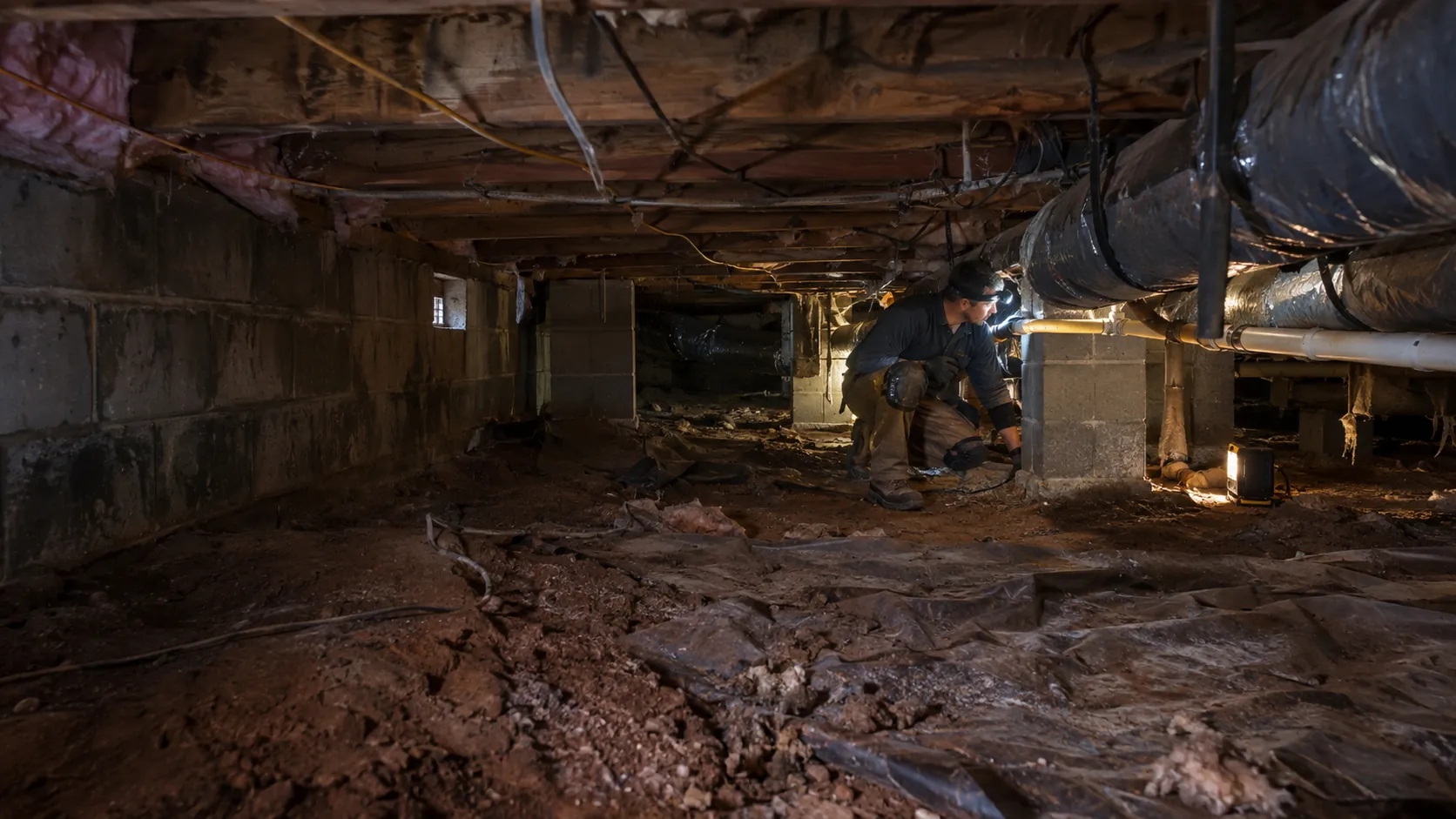
Most homes across the Triangle - from 1920s bungalows near downtown Raleigh to newer construction out in Cary - are built on crawl space foundations, not slabs or basements. That is a normal, sound way to build in this region. The problem is what sits underneath: Piedmont red clay that, once a lot has been graded and built on, sheds roof and yard water toward the foundation instead of soaking it up, paired with summer humidity that regularly runs 70-85% in an unsealed crawl space. That combination is what eventually shows up as a musty smell upstairs, condensation on ductwork, or - left long enough - soft, rotting floor joists.
None of it fixes itself, and none of it is visible from the living room. The only way to know what you are dealing with is for someone to get under the house and look.
What gets done down there
Eight kinds of work cover almost everything a Triangle crawl space needs:
- Crawl space repair - sagging floors, weakened joists and rotted subfloor, repaired from underneath.
- Encapsulation - a sealed liner across the floor and walls, closed vents and a dehumidifier: the complete moisture-control system.
- Vapor barrier installation - a proper ground cover, carried to the walls rather than stopping short of them.
- Waterproofing and drainage - interception, a perimeter drain and a sump for a crawl space that takes on water after heavy rain.
- Mold remediation - treatment of growth on joists and subfloor, alongside the moisture source that caused it.
- Dehumidifier installation - sized and fitted to hold humidity in a safe range through a Carolina summer.
- Insulation removal and replacement - wet, sagging or soiled batts taken out, the framing above them checked, and the right insulation put back for a vented or a sealed crawl space.
- Basement and foundation waterproofing - the same drainage trade applied to a basement that leaks or seeps after rain: interior drains, a sump, or an exterior membrane.
Which of those a house needs is not something to guess at from a web page. A damp crawl space and a wet one are different problems, and sealing a space that still takes on liquid water is how homeowners end up paying twice.
Across the Triangle
Coverage runs across 20 communities in six counties - Wake, Durham, Orange, Johnston, Chatham and Franklin - taking in Raleigh and Durham themselves, the fast-growing towns south and west of the city, the eastern Wake and Johnston County towns along the Neuse, and the older housing out through Orange and Chatham. The service areas page lists every one, with what is actually different about each.
The two largest cities have the most to say. Crawl space repair in Raleigh covers its three eras of crawl space construction, where each era is by ZIP code, and the historic-district approval that comes before exterior work. Crawl space encapsulation in Durham starts from the mill-era houses and their clearance problem, and the single city-county office that handles permits for both.
Tell us what you have noticed and we will follow up to schedule your free inspection - there is no obligation to hire anyone. How it works sets out the whole process, start to finish.