What installation involves
A crawl space dehumidifier is a permanently installed, continuously draining unit that pulls moisture out of the air under the house and sends it outside. Installing one well comes down to four decisions: how big, where it goes, how it drains, and what it is set to. Getting the first one wrong is the most expensive mistake, because an undersized unit runs nonstop without reaching its target, and an oversized one costs more to buy than it needs to.
It matters most in a sealed crawl space. North Carolina’s closed crawl space rules require a mechanical drying method once the vents are closed, and a dehumidifier is the usual choice. In a vented crawl space, a dehumidifier is drying air that is continually being replaced from outside - in a Triangle summer, at 70 to 85 percent relative humidity - which is why it so often disappoints there. If that is your situation, see encapsulation before buying a bigger unit.
Sizing: pints per day against square feet
Dehumidifiers are rated in pints of water removed per day, under a stated test condition. The makers of crawl space units also publish the square footage each model is meant to cover. The table below is taken from the manufacturers’ own data sheets.
| Model | Rated capacity (80°F, 60% RH) | At a cooler test point | Manufacturer’s coverage |
|---|---|---|---|
| Santa Fe Compact70 | 70 pints/day | 43.7 pints/day at 65°F | Crawl spaces 1,800-2,600 sq ft |
| AprilAire E070 | 70 pints/day | 53 pints/day at 73°F | Up to 2,200 sq ft (crawl spaces, basements or whole houses) |
| Santa Fe Advance90 | 90 pints/day | 71 pints/day at 70°F | Crawl spaces 2,200-3,000 sq ft |
| Santa Fe Advance120 | 120 pints/day | 91 pints/day at 70°F | Crawl spaces 2,900-3,700 sq ft |
Sources: Santa Fe data sheets for the Compact70 (TS-2108, 10/24), Advance90 (TS-1241, 01/23) and Advance120; AprilAire’s E070 product page and specification sheet. Santa Fe’s crawl space sizing assumes a 5-foot ceiling height. Checked 28 September 2026. Models are named to show how manufacturers size, not as recommendations.
Three things the table shows that a single pints-per-day number hides:
The headline rating is measured warm. 80°F and 60 percent humidity is warmer than a Triangle crawl space for much of the year. At 65°F, Santa Fe’s own figure for the Compact70 drops from 70 to 43.7 pints a day - close to 40 percent less. A crawl space that sits in the sixties needs that lower number in mind.
The code minimum is not a sizing guide. North Carolina’s closed crawl space section requires a dehumidifier rated at least 15 pints a day. Every crawl space unit above is several times that, and sized for spaces most Triangle houses fall within. The minimum exists so that something is installed, not to say what is enough.
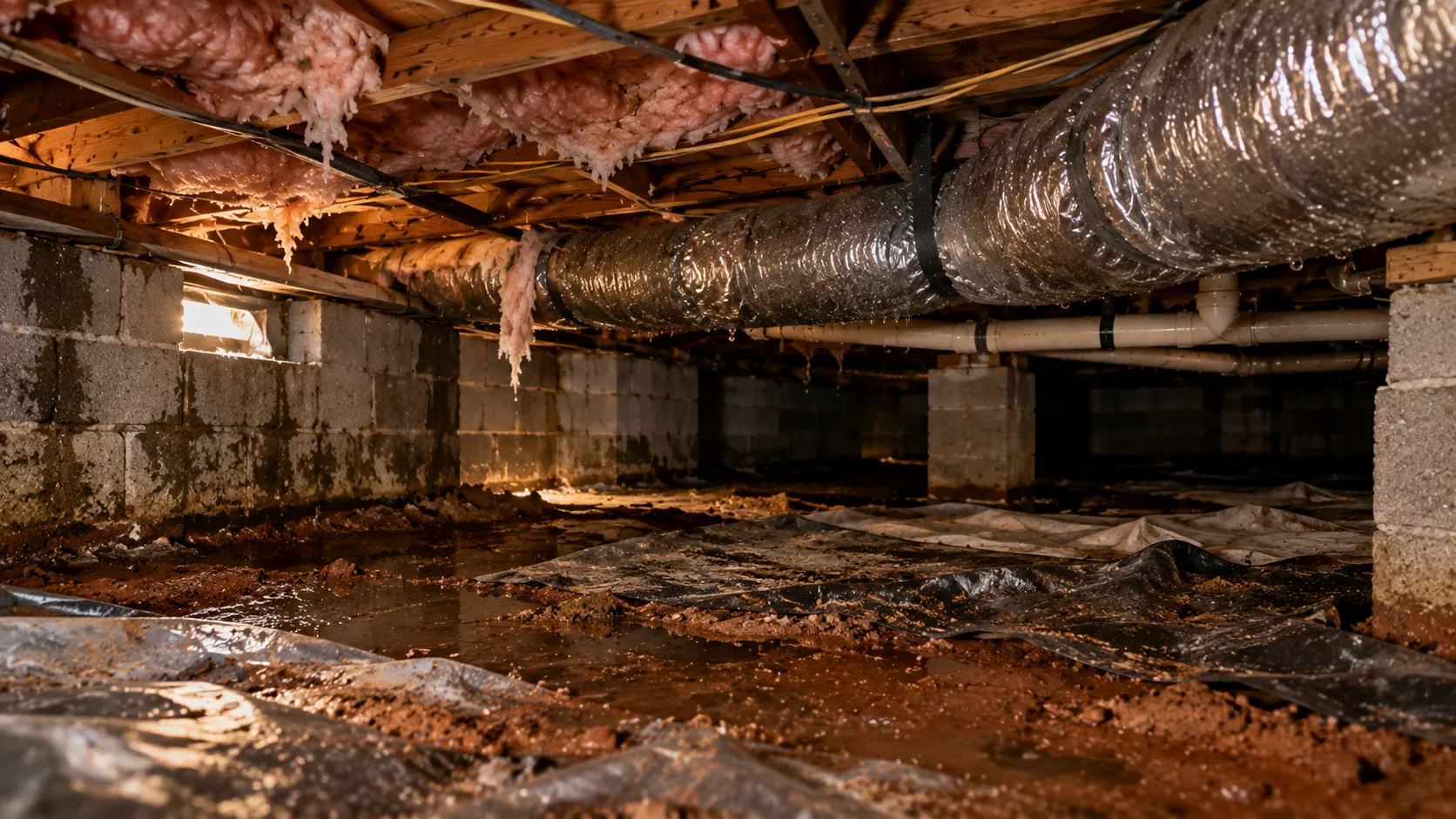
Coverage is a range, not a point. Where your crawl space falls within a unit’s range should depend on how much moisture it has to remove: a space that took on water before it was drained, has bare block walls, or has a low ceiling with little air movement belongs toward the bottom of a unit’s coverage.
Measure the floor area of the crawl space rather than estimating it from the house. Additions, porches on their own foundations and partitioned sections all change the number, and a partitioned crawl space may need ducting to reach its far side.
What it costs to run
Running cost is watts multiplied by hours multiplied by your electricity price, and hours is the variable nobody can quote in advance - it depends on how tightly the space is sealed and how wet it was to start.
The worked upper bound: Santa Fe rates the Compact70 at 444 watts (at 65°F and 60 percent humidity). Running 24 hours a day, that is about 10.7 kWh. The U.S. Energy Information Administration’s latest monthly figure puts North Carolina’s average residential price at 15.16 cents per kWh (July 2026, released September 24, 2026). So:
| Runtime | Energy per day | Cost per day | Cost per 30 days |
|---|---|---|---|
| Around the clock (24 h) | 10.7 kWh | about $1.62 | about $48 |
| Half the time (12 h) | 5.3 kWh | about $0.81 | about $24 |
| A quarter of the time (6 h) | 2.7 kWh | about $0.40 | about $12 |
Arithmetic only, from the two published figures above - not a measurement of any house. Larger units draw more: Santa Fe lists 640 watts for the Advance90 and 850 watts for the Advance120 at 80°F.
The number to watch is the runtime. A dehumidifier that runs around the clock through a summer is telling you something: it is undersized, the drain or filter is clogged, or the crawl space is not actually sealed and it is drying outside air. Each of those is cheaper to fix than to keep paying for.
Drain options
A crawl space dehumidifier drains continuously, so the question is where the water goes. North Carolina’s closed crawl space rules require condensate to be drained to daylight or to an interior condensate pump.
- Gravity drain to daylight. The simplest option, with no moving parts, where the drain line can fall continuously from the unit to an outlet outside the foundation. AprilAire’s installation manual calls for a constant downward slope from the unit to the drain or pump, and Santa Fe’s says a drain trap is required for the unit to run properly.
- Condensate pump. Where the water has to go up - over a footing, out through a rim joist - a small pump lifts it. AprilAire’s Model 4856 pump is rated to lift water up to 22 feet.
- Into an existing sump. Where the crawl space already has a sump basin, the condensate can often go there and leave with the drainage water. The code keeps crawl space floor drains separate from gutter and foundation perimeter drains, so ask how it is routed.
Wherever it ends outside, the outlet should be clear of the foundation and protected from freezing - a frozen line in January backs water into the unit.
Placement and power
The manufacturers’ installation instructions carry two details that matter in a crawl space:
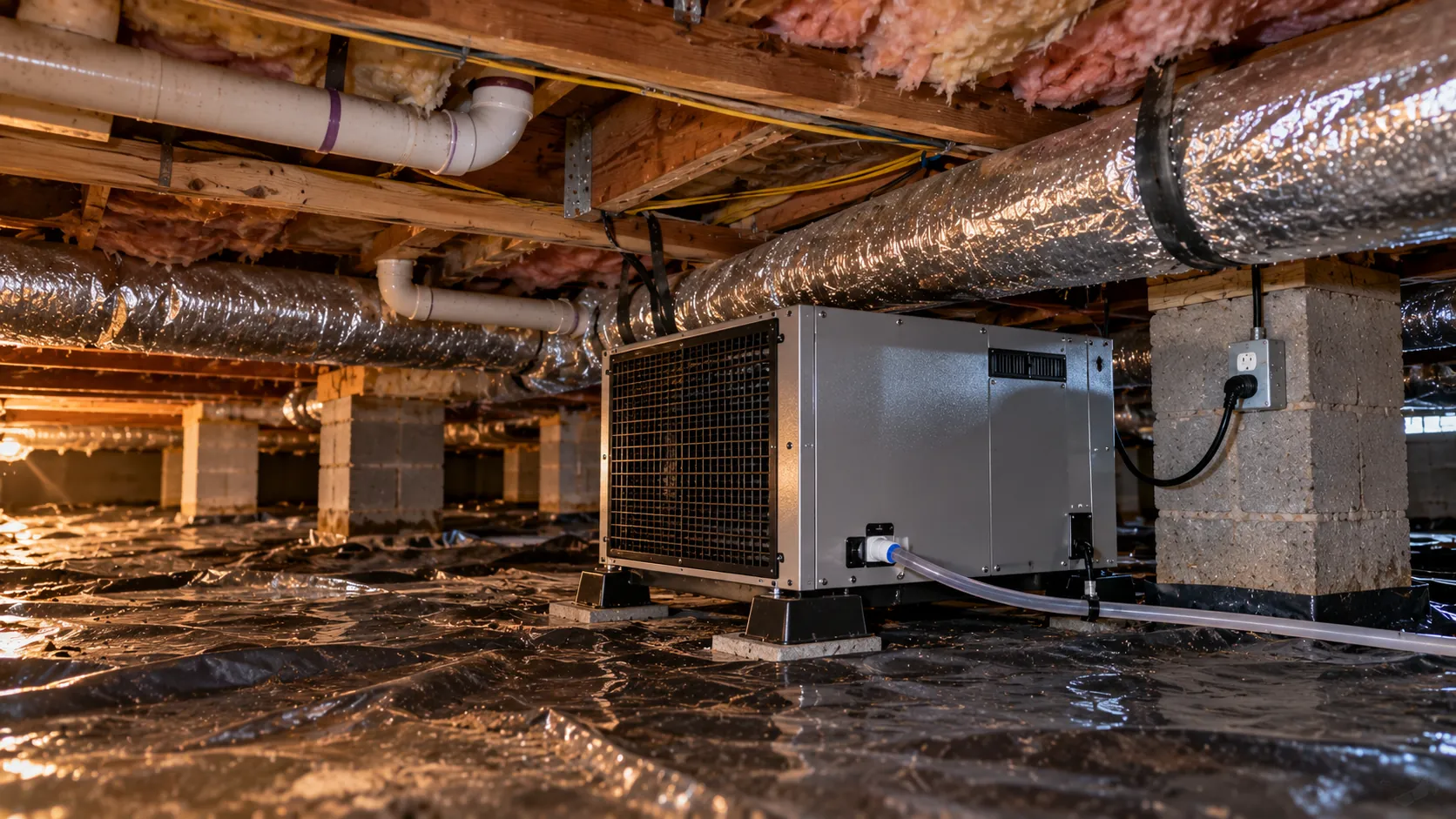
- Clearance. Santa Fe says not to install its units with the intake or exhaust within 12 inches of a wall or obstruction. AprilAire’s manual specifies 15 inches of clearance for filter access on either side of the E070. A unit jammed against a pier cannot move air or be serviced.
- Off the floor. Santa Fe’s manual says the unit should be hung from the floor joists where there is any possibility of flooding, and that a flooded unit is not covered by warranty. Santa Fe’s Compact70 data sheet describes it as sized to fit between floor joists for a hanging installation.
A closed crawl space dehumidifier must be provided with an electrical outlet under the code. Where there is no suitable circuit in the crawl space, adding one is electrical work - which is part of why converting to a closed crawl space needs a permit in North Carolina regardless of the job’s cost.
Maintenance
- Filter. AprilAire’s manual says to check and clean the washable MERV 8 filter and the drain every six months. Santa Fe’s crawl space units use a pre-filter and a MERV-13 filter, to be checked and replaced every three to six months.
- Drain. Check the outlet runs, the trap has not dried out, and a condensate pump still cycles.
- Reading. A cheap hygrometer in the crawl space, checked occasionally through the summer, tells you whether the unit is still holding the space below 60 percent.
A clogged filter or a blocked drain is the usual reason a working dehumidifier stops keeping up, and both are five-minute fixes.
Lifespan and warranty
No independent source publishes a reliable service life for crawl space dehumidifiers, so be cautious with any single figure. The warranties are published: AprilAire’s crawl space units carry a five-year warranty from the date of purchase, and Santa Fe markets a six-year warranty program on its units. Read what the warranty requires - Santa Fe’s excludes a unit that has been flooded, which is another reason to hang it.
What it costs to install
The table below shows the published installed range with its source and the reason it is only a loose guide: sources for this job disagree by several times. Much of that spread is what “installation” includes - a unit set on a block and plugged into an existing outlet is a different job from one hung, trapped, drained to daylight and given a new circuit. When comparing quotes, ask for the make, model and rated capacity, how it drains, whether a new outlet is included, and what the warranty covers. Every published range on the site is on the cost hub.
Humidity control is a frequent request in Morrisville, Cary and Raleigh.
Last updated